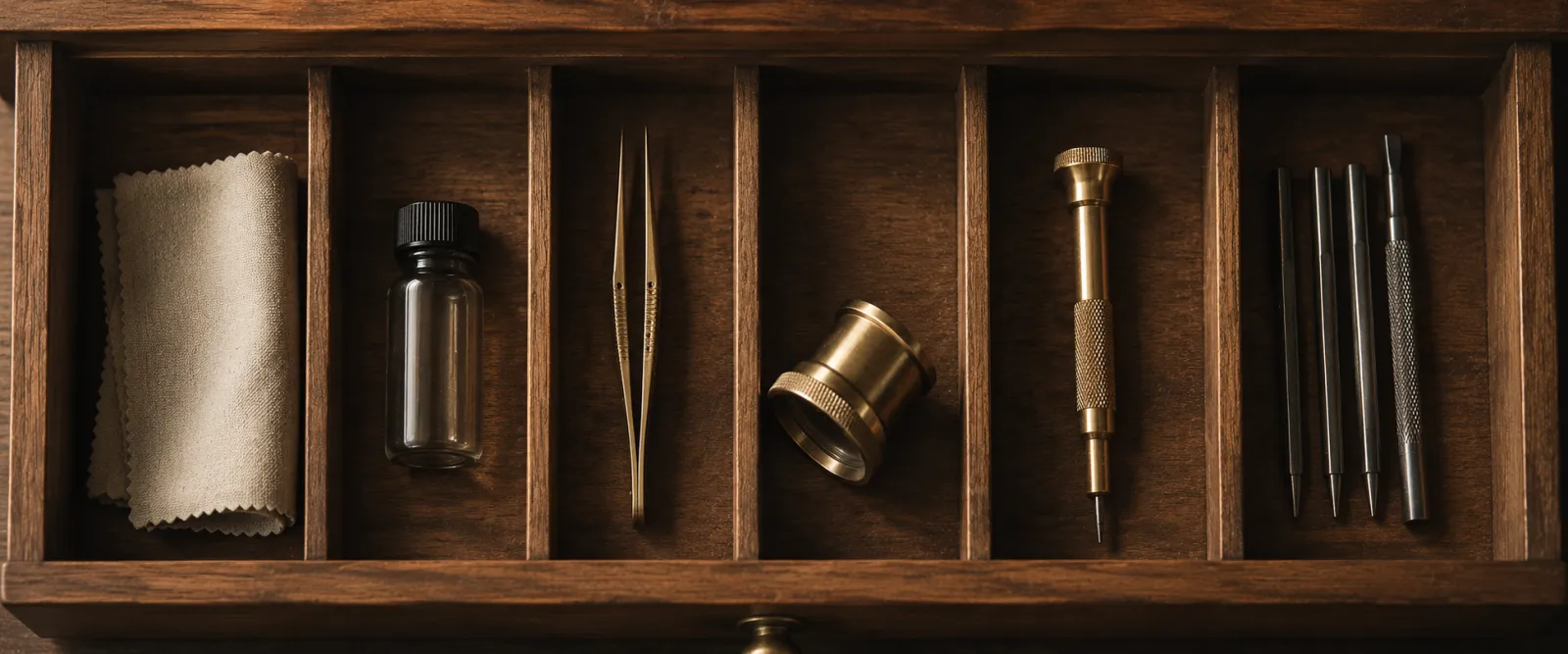
What we actually use at the bench. Organized from "buy this first" to "save up for later." Each recommendation is something we've used or that the community consistently recommends.
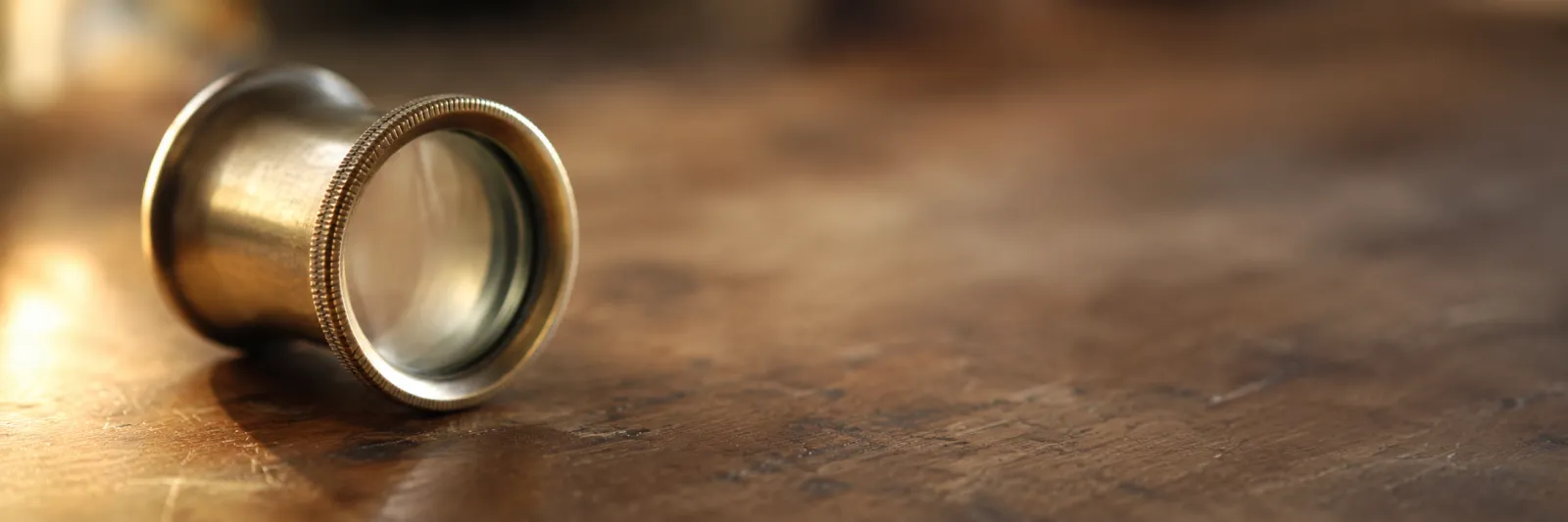
You can't fix what you can't see. A good loupe is your most important purchase.
The classic watchmaker's loupe. 10x magnification in a small, optically excellent package. Fits in an eye socket or on a headband adapter.
~$30 — Best bang for the buck
Swiss-made, wider field of view than the Bausch & Lomb. The industry standard if budget allows.
~$60
Hands-free magnification for assembly and disassembly. 2.5x with 8" focal length — perfect working distance. Wear it with a loupe for dual magnification.
~$35 — Every watchmaker owns one
Watchmaking screwdrivers have flat, parallel blades (not tapered). You need sizes from 0.5mm to 2.5mm.
Chinese-made but perfectly functional for learning. Sizes 0.5mm to 2.5mm. Replace blades as you learn to sharpen them properly.
~$15-25 — Fine for your first year
The gold standard. Perfectly ground blades, smooth action, excellent ergonomics. You'll want these eventually — but you don't need them to start.
~$250 — Buy when you're committed
Removing and installing hands without damaging the dial requires the right levers.
Spring-loaded levers that lift hands cleanly. Get the genuine Presto — cheap knockoffs flex and scratch dials. Protect the dial with a plastic sheet.
~$20-30
Hollow-ended pushers for pressing hands back onto their posts without touching the dial. Get a set with multiple sizes.
~$15
Thin plastic sheets with a center hole. Slide under the hands before using levers. Prevents scratches on the dial surface.
~$5-8 for a pack
You'll use tweezers more than any other tool. Start with brass (forgiving) and graduate to steel.
Won't magnetize parts or scratch components. Softer tips are more forgiving while you develop technique. Get a fine-point and a flat/angled pair.
~$8-15
The watchmaker's workhorse. Fine point, spring tension, anti-magnetic. Dumont #5 is the shape — many brands make them. Regine and genuine Dumont are the best.
~$15-30 (genuine Swiss: $50+)
Opening cases without damage. Pocket watches are usually simpler (pry with a case knife), wristwatches need more specialized tools.
For snap-back cases and pocket watch case backs. Thin, flexible blade slides into the seam. Essential — you'll use it on almost every watch.
~$5-10
For screw-back wristwatch cases. Adjustable pins grip the notches in the case back. Essential for modern watches.
~$15-40
Holds the movement securely while you work on it. Adjustable for different sizes. Generic versions work fine.
~$10-20
A timegrapher measures rate, amplitude, and beat error using a contact microphone — far more accurate than any phone app. Use our Timegrapher Results form to record readings.
The hobbyist's standard. Measures rate, amplitude, and beat error. Chinese-made but reliable for the price. Adequate for most hobby work.
~$150-200 — Best value for hobbyists
Adds a larger display, more beat rates, and slightly better microphone sensitivity. Worth the upgrade if you're doing regular service work.
~$250-300
Swiss-made professional timing machine. Higher sensitivity, better signal processing, computer connectivity. What professional shops use.
$1,000+ — Professional investment
Proper lubrication is the difference between a service lasting 3 years or 10. The oils matter — they're engineered for specific applications.
Synthetic oil for the escapement (pallet stones, impulse jewel) and fast-moving pivots. Low viscosity, excellent capillary properties. The most important single oil to own.
~$25-35 for 2ml — Lasts years
For the gear train pivots (center, third, fourth wheels). Slightly thicker than 9010. Between these two oils you can lubricate most of a movement.
~$25-35 for 2ml
Applied inside the barrel to the mainspring. Reduces friction and prevents the spring from sticking. Essential for a proper mainspring service.
~$20-30
Precision oilers with tiny cups at the tip that hold a controlled amount of oil. You need a fine oiler and a medium oiler at minimum.
~$10-20
Use our Mainspring Calculator to find the right spring dimensions for your barrel.
A set of winding barrels for coiling mainsprings. Get a set that covers common sizes. Avoid trying to hand-wind mainsprings without one — you'll kink the spring.
~$25-50 for a set
Safely releases mainspring tension before disassembly. NEVER skip this step — an uncontrolled let-down can destroy the entire gear train in a fraction of a second.
~$15-25 — Non-negotiable safety tool
Parts must be spotlessly clean before oiling. Contamination is the #1 cause of premature service failure.
Sharpen and use to clean jewel holes, pivot holes, and small recesses. Absorbs oil and dirt. The oldest cleaning tool in watchmaking — still essential.
~$5-10 for a bundle
Blue putty that picks up dust, lint, and fingerprints from parts without leaving residue. Press onto a surface and lift. Indispensable.
~$8-12
For cleaning parts in solution. A small heated unit (600ml+) with a parts basket works well. Use proper watch cleaning solution, not just water.
~$40-80
The best watchmaking books are old but still definitive. These are the ones you'll keep reaching for.
THE beginner's book. Clear, methodical, covers everything from basic disassembly through regulation. Written in 1946, still the best introduction. Every watchmaker owns a copy.
~$20-30 paperback
The master's comprehensive reference. Covers theory and practice at a deep level. More advanced than de Carle — read it after you've done a few services.
~$40-60
American perspective on watch repair. Excellent on American pocket watches and has good material on case work and cosmetic restoration.
~$25-40
The textbook used in Swiss watchmaking schools. Technical, mathematical, comprehensive. For when you want to understand the engineering behind the craft.
~$60-80
Learn on cheap movements you can afford to break. Never practice on something sentimental or valuable.
Chinese clone of the ETA 6497/Unitas. Large, visible, hand-wind. Under $30 for just the movement. Perfect for learning basic service: teardown, clean, oil, reassemble.
~$25-40 — The ideal learning movement
Large, visible parts. Readily available on eBay for $30-60 in running condition. American movements are well-documented with serial number databases.
$30-60 on eBay — Parts still available